DIY Aluminium Kit Boat FAQs
What Makes Wavemaster Kits Different?
It’s the small but critical details that matter: how plates behave when welded, how structure is arranged to resist distortion, and how a kit is sequenced so it pulls straight instead of fighting you. Details in hull proportions and chine geometry are just as important.
Wavemaster hulls are based on long term on water experience, rigorous analysis and decades of production experience, prioritising comfort and dryness over aggressive features that compromise ride quality and ease of fabrication.
Wavemaster hulls are based on long term on water experience, rigorous analysis and decades of production experience, prioritising comfort and dryness over aggressive features that compromise ride quality and ease of fabrication.
.jpg "Aluminium kit boat tacked up")
When skill and great hull plate development are aligned
Who are Wavemaster kits designed for?
Wavemaster kits are designed with professional fabrication practices in mind, using build methods aligned with commercial shipbuilding rather than compensating for inconsistent fabrication quality.
Structural detailing, weld sizing, and part fit up are engineered to minimise heat input and distortion, allowing experienced fabricators to work efficiently without relying on excessive welding or correction.
This approach reduces build hours, improves fairness, and produces a cleaner, more professional result — while remaining accessible to capable DIY builders who want to work to a higher standard.
Structural detailing, weld sizing, and part fit up are engineered to minimise heat input and distortion, allowing experienced fabricators to work efficiently without relying on excessive welding or correction.
This approach reduces build hours, improves fairness, and produces a cleaner, more professional result — while remaining accessible to capable DIY builders who want to work to a higher standard.
Should I build a kit myself or buy a professionally built Stage 1 bare hull?
Both paths can work, but the right choice depends on your skills, time, and what you value most. In many cases a stage 1 bare hull is a much better option. A full DIY build can be rewarding for experienced fabricators with the tools, space, and confidence to execute high quality structural welds. However, some DIY builders would be better off with a professionally built Stage 1 bare hull because it removes the highest risk and most time critical part of the project. One of the biggest risks in a full DIY hull build is bucking or distortion of the bottom and side sheets, which is difficult, and sometimes impossible to correct, and can seriously impact both appearance and resale value.
The good news is that the cost difference is often less than expected. Professional builders work on an all inclusive rate covering wire, gas, consumables, power, and of course their professional experience, whereas DIY builders pay retail prices for these items, and they can add up. Significant savings can still be achieved by completing the fit out yourself while starting with a high quality professionally built complete hull.
If you prefer a stage 1 build we can supply the kit directly to your preferred builder.

A professionally built stage 1 kit boat reduces the risk of bucking and weld defects. This one built by Marineline Boat Builders.
Should I attend a boat building course before starting?
This is a common question, and in most cases the answer is no.
If you feel you need a course because you don’t yet have the skills, it is usually better to put that money, along with the cost of a good welding machine, towards a professionally built Stage 1 bare hull. Boat building courses can help with general fabrication skills, but many are not aligned with how modern aluminium kits are actually built. Some focus heavily on TIG welding or large group projects, neither of which reflects the reality of small, DIY plate boat construction. Much of the time may be spent practising welds at a bench (which you can do at home using kit offcuts), or standing around watching others work. Wavemaster kits are designed for solo or two person builds using MIG welding and standard fabrication tools, supported by detailed plans, precision cut parts, and a clear weld schedule.
Significant savings can still be achieved with a stage 1 hull by completing the fit out yourself, while avoiding the highest risk structural work. So before enrolling, ask whether the course genuinely delivers value, and whether it is realistic to replicate a four year apprenticeship in a weekend, and whether the real objective of the course is an upsell into an overpriced kit. Finally, if you do consider a course, before enrolling, it’s worth asking whether the course genuinely reflects modern aluminium kit construction, and whether appropriate insurance is in place. If you are injured during a course or while applying the methods taught, understanding where responsibility lies is important.
Do I need to know how to TIG weld to build a Wavemaster kit?
No. TIG welding is not required. Wavemaster kits are engineered to be MIG-welded, which is the marine industry standard for aluminium boatbuilding, including 5083 plate in 3mm to 5mm thicknesses.
MIG is faster, more forgiving, and much more suited to long structural welds than TIG, which is typically reserved for fine fabrication, cosmetic welds, or thin aluminium under 2mm. TIG is slower, requires highly clean surfaces, and demands significantly more setup time and skill, making it impractical for most boat hulls.
All Wavemaster kits are designed for straightforward MIG welding. You can practice welds on offcuts from the kit before starting the hull, and our detailed drawings guide every step of the process.
MIG is faster, more forgiving, and much more suited to long structural welds than TIG, which is typically reserved for fine fabrication, cosmetic welds, or thin aluminium under 2mm. TIG is slower, requires highly clean surfaces, and demands significantly more setup time and skill, making it impractical for most boat hulls.
All Wavemaster kits are designed for straightforward MIG welding. You can practice welds on offcuts from the kit before starting the hull, and our detailed drawings guide every step of the process.
MIG-welded Wavemaster hull showing no distortion .
Proof that professional results are achievable with the right process and equipment.
How is welding aluminium different to welding steel?
Welding aluminium is quite different from welding steel — and the change in technique often surprises DIY builders who come from a steel fabrication background.
Aluminium dissipates heat much faster than steel, which means you need to weld “hot and fast” to achieve full penetration without excessive distortion. That’s why MIG welding aluminium requires a higher travel speed and greater heat input than most steel welders are used to.
Gas selection is also important. For aluminium, a pure argon or argon-helium shielding gas mix is required — not the standard mixes commonly used with steel.
Finally, aluminium requires much cleaner preparation: oxide layers must be removed before welding, and there’s no “forgiveness factor” like there is with mild steel. Clean metal, a dialled-in welder, and good technique will deliver excellent results — and our kits are designed to support that process every step of the way.
Aluminium dissipates heat much faster than steel, which means you need to weld “hot and fast” to achieve full penetration without excessive distortion. That’s why MIG welding aluminium requires a higher travel speed and greater heat input than most steel welders are used to.
Gas selection is also important. For aluminium, a pure argon or argon-helium shielding gas mix is required — not the standard mixes commonly used with steel.
Finally, aluminium requires much cleaner preparation: oxide layers must be removed before welding, and there’s no “forgiveness factor” like there is with mild steel. Clean metal, a dialled-in welder, and good technique will deliver excellent results — and our kits are designed to support that process every step of the way.
What are the advantages of deep girders?
As mentioned above, many early kit boats were designed for the DIY scene and used the "pull up" method where plates are laid on the floor and pulled up into shape. That approach has advantages and works well or smaller designs, but it can limit the structural efficiency of and internal space on larger boats. Think about it. Do you think it makes sense to build an 8m boat the same way as a 4m?
Longitudinal girders, especially deep ones, are difficult to get level with the pull-up method. But as boats get longer, these girders become more useful because they:Provide superior strength and rigidity for boats that go further offshore.Reduce flexing and panel vibration for boats with more power.Support larger, more integrated fuel tanks.Result in easier plating and a more refined finish.Enable a quieter, smoother ride on the water. Make construction of large boats more efficient. Instead of fighting gravity to pull plates up with come-a-longs, the upside down build using girders as the back bone allows the plates to be laid over the frames where gravity helps push them into shape.
Wavemaster’s hulls can be designed for either upside down assembly with girders or pull up assembly without girders.
Longitudinal girders, especially deep ones, are difficult to get level with the pull-up method. But as boats get longer, these girders become more useful because they:Provide superior strength and rigidity for boats that go further offshore.Reduce flexing and panel vibration for boats with more power.Support larger, more integrated fuel tanks.Result in easier plating and a more refined finish.Enable a quieter, smoother ride on the water. Make construction of large boats more efficient. Instead of fighting gravity to pull plates up with come-a-longs, the upside down build using girders as the back bone allows the plates to be laid over the frames where gravity helps push them into shape.
Wavemaster’s hulls can be designed for either upside down assembly with girders or pull up assembly without girders.
How is your boat length defined?
In the past length was usually stated as the distance between the point where the transom meets the keel and the bow where the side plates meet. It excluded appendages, platforms and bow spits and was known as "bung to bow". However this is not how length is defined in the National Standard for the Australian Builders Plate for Recreational Boats. The standard defines Length as "a term having the same meaning as 'length of hull' in ISO 8666". AS1799.1 also refers to ISO 8666. The definition of Length in this standard is basically the overall length of the enclosed hull volume.
This means that any enclosed hull volume aft of the bung should be included in the definition. The angle of the transom and the height of the decks are important since they determine the extents of the enclosed volume.
Why does it matter? The official length for the builders plate determines cut off points for flotation requirements and life jacket wearing regulations.
The bung to bow length is dated and not relevant to any standards.
For this reason we use the Length as defined in ISO 8666 to describe our boat length.
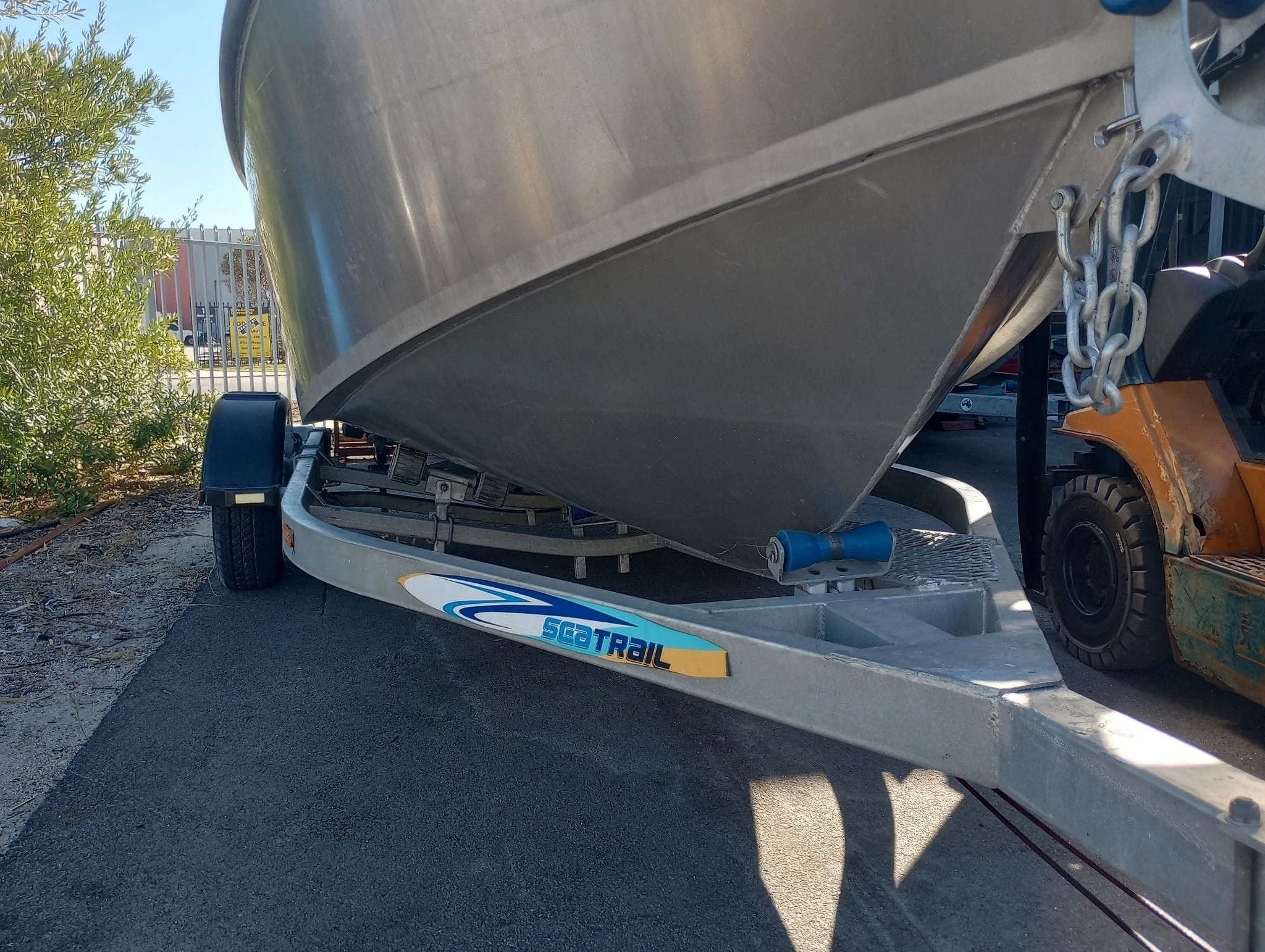
Do you supply aluminium boat trailer plans and kits?
Aluminium trailers have become popular in the DIY market. We’ve made a conscious decision not to supply them, and that decision is based on engineering, durability, and liability considerations, not trends.
In practice, DIY boat trailer kits are often over designed and are rarely lighter than professionally built aluminium boat trailers and even equivalent steel trailers.
The cost savings may not be as much as you might think because you will be paying retail prices for all of the fittings, brakes, wiring etc.
Most importantly, since trailers are road going structural systems, failures carry serious safety and liability implications, which is why we recommend professionally manufactured trailer solutions and focus our expertise on boat design.